
Missing Upper Lateral Incisor Teeth: A Guide for Parents and Patients
Providing the orthodontic care and attention
we would want for our own family and friends.
If your child’s dentist has mentioned that a lateral incisor, the tooth right next to the front two teeth, might never come through, you are not alone. Congenitally missing teeth are one of the most common developmental variations in dentistry, and the upper lateral incisors are among the teeth most frequently affected. This guide explains why lateral incisors go missing, how common the condition really is, and the treatment options available, from orthodontic space closure through to bridges and dental implants, so you can make an informed decision alongside your orthodontist.
At Camberwell Orthodontic Group, a large part of our practice is dedicated to treating children and guiding families through exactly this kind of diagnosis. Picking up a missing lateral incisor early, often well before all the adult teeth have erupted, gives us far more options for how to manage the space and plan treatment around it.
What does congenitally missing teeth mean?
Congenitally missing teeth, sometimes called congenitally absent teeth (hypodontia), occur when a tooth simply never develops. Dentists use a few related terms depending on how many teeth are affected. Hypodontia describes the absence of up to six teeth, oligodontia describes six or more missing teeth, and anodontia refers to the complete absence of teeth, which is rare. Most patients with a missing lateral incisor fall into the hypodontia category, often with just one or two teeth affected.
This is different from a tooth that has been lost to injury, decay, or gum disease later in life. A congenitally missing tooth was never there to begin with, because the tooth bud failed to form during early development.
What causes congenitally missing teeth?
Genetics is the leading cause. Research into tooth agenesis has identified specific genes, including MSX1, PAX9 and AXIN2, that play a role in whether a tooth bud forms properly, and the condition often runs in families. A study on the genetics of maxillary lateral incisor agenesis confirms that hypodontia has a strong genetic component and is frequently inherited.
In most cases, a missing lateral incisor is an isolated, non-syndromic finding, meaning it happens on its own without any wider health condition. Less commonly, missing teeth can be associated with a genetic syndrome, so if several teeth are affected, or if there are other developmental signs present, your orthodontist may recommend a broader assessment.
How common are missing lateral incisors?
Missing lateral incisors are one of the most frequently congenitally absent teeth, second only to the wisdom teeth and lower second premolars in most populations. Reported rates vary depending on the population studied. One large review of maxillary lateral incisor agenesis found prevalence rates ranging from around 2 percent to as high as 12 to 13 percent across different countries, while a study of an orthodontic adolescent population found a prevalence of 3.77 percent, with the condition noticeably more common in females than males.
In practical terms, this means that in an average classroom of thirty children, it would not be unusual for at least one to be congenitally missing a lateral incisor. It is a common finding, not a rare or unusual one, and it is very manageable with the right treatment plan.
What are the most common congenitally missing teeth?
Across most populations, the teeth most likely to be congenitally missing, in order of frequency, are the wisdom teeth, the lower second premolars, and the upper lateral incisors. Because the lateral incisors sit right at the front of the smile, their absence tends to be noticed far earlier and causes more concern for parents than a missing wisdom tooth or premolar further back in the mouth.
At what age do kids lose their lateral incisors?
Baby, or primary, lateral incisors are usually shed naturally between around 7 and 8 years of age, with the adult lateral incisor typically erupting shortly afterwards, generally between 8 and 9 years. If the adult tooth does not appear within a reasonable window after the baby tooth falls out, or if the baby lateral incisor never had a permanent tooth developing behind it, this is usually the point where a dentist or orthodontist will investigate further, often with an x-ray to confirm whether the permanent tooth is present, delayed, or congenitally absent altogether.
This is one of the reasons the Australian Society of Orthodontists recommends children have their first orthodontic evaluation by around age 7 to 8. A congenitally missing lateral incisor is far easier to plan around when it is picked up while a child still has growing jaws and a mix of baby and adult teeth.
Can I live with one missing tooth?
Technically, yes, and some adults do go through life with an untreated gap. However, a missing lateral incisor rarely stays neutral over time. Neighbouring teeth can drift or tilt into the empty space, the bite can shift, and the surrounding gum and jawbone can gradually lose volume without a tooth root to stimulate them, which can make treatment more complex the longer it is left. For a tooth in such a visible part of the smile, most patients also find the aesthetic impact difficult to ignore.
Can missing teeth affect confidence and self-esteem?
This is a fair question, and the research on it is worth understanding rather than dismissing. A study on the psychosocial impact of dental aesthetics found that patients presenting with missing teeth scored significantly lower on self-esteem measures than patients seeking treatment for other cosmetic concerns. Missing front teeth can affect how comfortable someone feels smiling, speaking, or being photographed, particularly in the teenage years when appearance-related self-consciousness tends to peak.
We would stop short of saying a missing tooth causes depression, as that is a clinical diagnosis that depends on many factors beyond dental appearance. What the evidence does support is a real link between visible missing teeth and lower self-esteem, which is one of the reasons we treat this condition as more than a purely cosmetic issue. If you or your child are experiencing broader difficulties with mood or wellbeing, that is worth raising with your GP alongside any dental treatment.
What are the available options for missing teeth in Australia?
There are four main treatment options for missing lateral incisors, and the right choice depends on the patient’s age, the size of the gap, the position of the adjacent teeth, and long-term aesthetic goals.
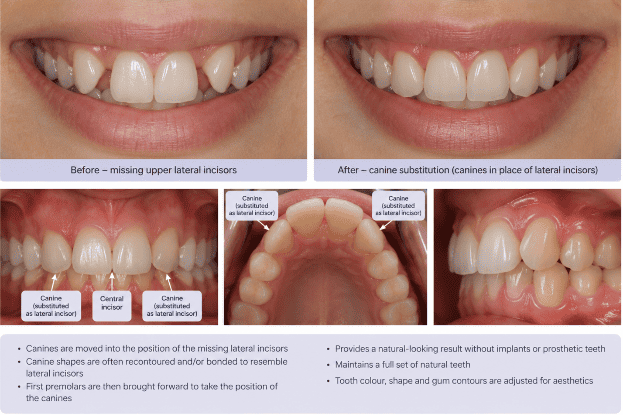
Orthodontic space closure. Braces or clear aligners are used to bring the canine tooth forward into the lateral incisor position, then reshape it to look like a lateral incisor, often with the help of composite bonding or a crown. This is one way to fix missing teeth without an implant, and it can be a strong option in the right bite, particularly when treatment starts while a child or teenager is still growing.
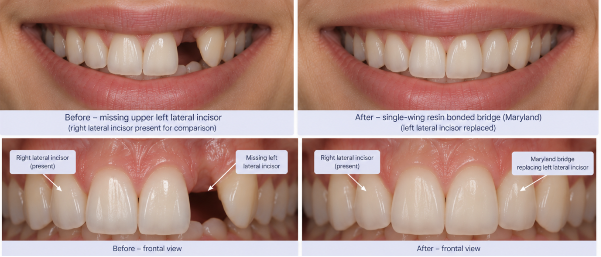
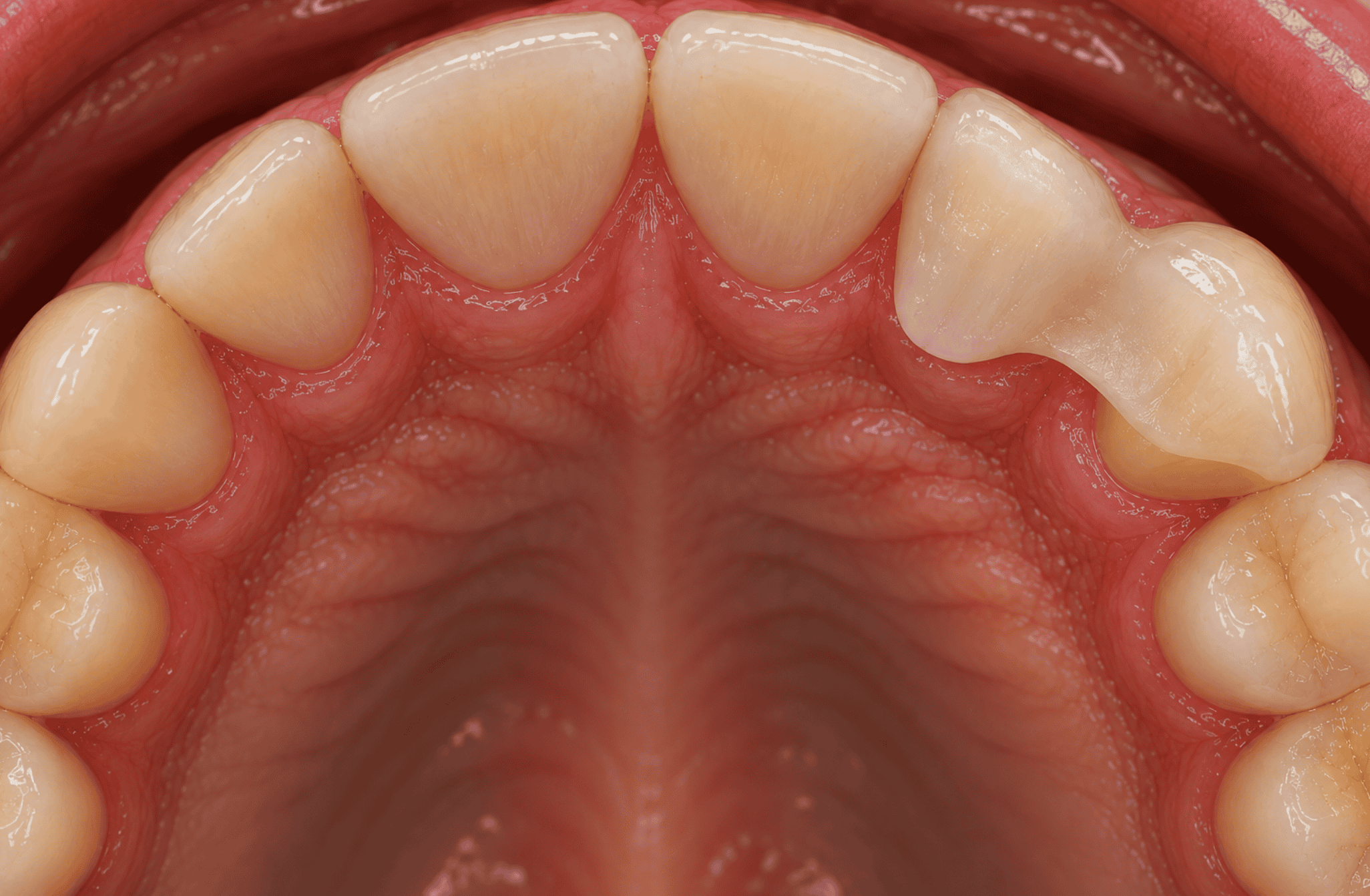
Resin-bonded bridge. Also known as a Maryland bridge, this uses a false tooth bonded to the back of the neighbouring teeth without needing to grind them down significantly. It is a relatively conservative, reversible option that can work well as an interim solution for a growing child, since jaw growth needs to be complete before a permanent implant can be placed. This is the most popular approach for teenagers and young adults.
Dental implant. A titanium post is placed in the jawbone to act as an artificial tooth root, topped with a custom crown. Implants are generally considered the gold standard for missing lateral incisors in adults because they do not rely on the neighbouring teeth for support and can last for decades with good care. Implants are not suitable until the jaw has finished growing, which is usually in the mid 20s.
Removable partial denture. A removable option that can be used as a temporary measure, particularly for younger children, while a longer-term plan is put in place.
What is the best option for missing lateral incisors?
There is no single best option for every patient. As orthodontists, our role is to assess the whole picture, including how much space is available, whether the canine and other teeth can realistically be repositioned, the patient’s age, and how the bite comes together, before recommending a direction. In many younger patients, orthodontic space closure or space redistribution to prepare for a future Maryland bridge or implant is the most efficient path, since it works with growth rather than against it. In adults with well-aligned teeth and adequate space, an implant is often the preferred long-term solution. This is exactly why an orthodontic consultation, ideally in coordination with your general dentist, is the right starting point before committing to any single treatment.
How much does it cost to fix missing lateral incisors?
Cost varies considerably depending on the treatment path, the number of teeth involved, and whether any preparatory orthodontic work is needed first. Orthodontic treatment is usually needed to redistribute the spaces evenly and to align the roots parallel with each other (in case an implant will be done in the future). The orthodontic treatment is done first with an Orthodontist. Maryland bridge and implant options are done by dentists or specialist Prosthodontists after orthodontic treatment. Orthodontic alignment can range between $3000-$12000. This is a wide range, as the price would depend on what is required (top teeth for a cosmetic fix, vs top and bottom to fix the way teeth touch; and whether there are any other orthodontic issues needing to be fixed too (such as overbites). The most common fee range for orthodontics is $8000 – $11000, divided into small instalments over the treatment period. This means treatment cost can be broken down into smaller portions, making treatment more accessible.
When it comes to the actual replacement of the lateral incisor, the treating clinician would provide their own quote. As a general guide, a single dental implant in Australia, including the implant itself, the abutment and the crown, typically costs somewhere in the range of $3,000 to $7,000 once the jaw has finished growing, while a resin-bonded bridge or orthodontic space closure plan will usually cost a lot less, though pricing depends heavily on individual circumstances. Because every case is different, and because timing matters so much with growing patients, the most useful next step is a consultation, where we can map out the sequence of treatment and give you a personalised estimate rather than a generic figure.
What dental work can you have when you have missing teeth?
Beyond the direct replacement options already covered, patients with missing lateral incisors sometimes need supporting treatment such as orthodontic alignment of adjacent and opposing teeth, minor reshaping or bonding of the canine if it is being moved into the lateral incisor position, or bone grafting prior to an implant if the jawbone has lost volume over time. Your orthodontist and dentist will work together to sequence this appropriately, usually starting with any necessary tooth movement before restorative work goes ahead.
Which teeth cannot be replaced?
In practical terms, almost any missing tooth can be replaced in some form, whether through an implant, bridge, denture, or orthodontic repositioning of an existing tooth. The exceptions tend to be specific clinical situations rather than particular tooth types, for example where there is insufficient bone or gum support even after grafting, or where a patient’s overall health makes surgery unsuitable. In those cases, a well-planned bridge or denture can usually still restore appearance and function even if an implant is not on the table.
Why see an orthodontist about a missing lateral incisor?
A missing lateral incisor is not purely a restorative dentistry problem. How the surrounding teeth are positioned, whether the canine can be moved into place, and how much space is available all fall squarely within an orthodontist’s expertise, and getting this assessment right early often determines how straightforward the rest of treatment will be.
This is where our experience really counts. At Camberwell Orthodontic Group, we see a high volume of young patients and have built our practice around making early diagnosis and treatment planning as comfortable and clear as possible for both children and parents. Picking up a congenitally missing lateral incisor at the first orthodontic evaluation, well before the window for growth-friendly treatment closes, gives your child the widest possible range of options later on.
If you have noticed a gap where an adult lateral incisor should be, or your dentist has flagged one as congenitally absent, we would encourage you not to wait. Book a consultation with our team, and we will talk you through what we see, what your options are, and the timeline that makes sense for your child or yourself. You can also read more about our approach to early orthodontic treatment for kids and our orthodontic treatment options more broadly.

By: Yana Itskovich, Specialist Orthodontist.
Yana is a registered dental practitioner since 2008, having completed Fellowship examinations and then specialist training at the University of Otago, New Zealand in 2016 and is co-owner of Camberwell Orthodontic Group.
More Articles:

Playing Instruments with Braces: A Guide for Brass and Woodwind Musicians
If you or your child plays in the school band and is about to start orthodontic treatment, the first question…
Protecting Your Child’s Smile: The Importance of Mouthguards for Sport
By Dr Yana Itskovich, Specialist Orthodontist As an orthodontist, one of my key priorities is helping patients protect their teeth…
Spark Aligners VS Invisalign: Which Clear Aligner System Is Right for You?
Gone are the days when the only way to straighten your teeth was to put up with traditional metal braces,…

LightForce White Ceramic Vs Metal Braces
When it comes to achieving that perfect smile, advancements in orthodontic technology in recent times has revolutionised the way we…